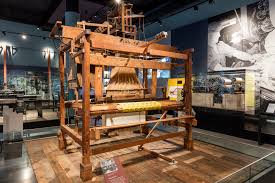
Ah, the Jacquard loom. The unsung hero of fabric-making and the distant ancestor of modern computing. Invented in 1804 by Joseph Marie Jacquard (because naming things after yourself is cool I guess), this loom automated weaving with punch cards, replacing tedious handwork. Complex designs that once took an eternity to weave (or as Cutting would say, one day, one inch, or two people, one inch) could now be produced with far less effort—unless, of course, you were a weaver suddenly out of a job.
Naturally, weavers of the time—known as the Canuts—were outraged, responding with the rational solution of smashing the looms. Their fear of automation taking over their craft wasn’t entirely unfounded, considering history has a habit of repeating itself. Still, despite their protests, the Jacquard loom thrived, setting the stage for a world where machines slowly but surely took the reins from human hands.
The Jacquard loom not only revolutionized textiles but also played an unexpected role in computing history. Charles Babbage took inspiration from its punch card system for his Analytical Engine, a precursor to modern computers. So next time you admire a patterned fabric, remember: technology replaced humans once again, and we’re all better dressed—and possibly unemployed—for it.